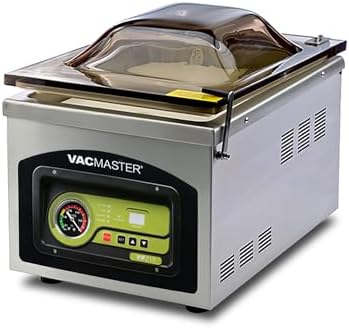
The Avid Armor Ultra USV20 is a countertop chamber vacuum sealer, and that one fact decides most of this review. If you seal marinades, braises, stocks, or raw meat that arrives wet, it removes a workaround you have been living with. If you seal dry portions and frozen solid food a few times a week, a good external sealer does the same job with less counter space and less money. Buy this machine for the liquids, not for the label.
It is aimed at a home kitchen that cooks in batches: bulk meat buys, Sunday prep, sous vide, a freezer that fills and empties. Not at someone who wants an appliance in a drawer.
As an Amazon Associate I earn from qualifying purchases.
What a chamber sealer does that a bar sealer cannot
An external sealer, also sold as a bar or suction sealer, clamps the open end of a bag onto a heated bar and pulls air out through the bag itself. That is why the film has to be embossed or channeled: the texture is the path the air travels along. The weakness is built in. Air and liquid leave through the same opening, so anything wet near the seal travels toward the pump or sits between the layers of film and prevents a clean weld.
A chamber sealer puts the whole bag inside a closed compartment and evacuates the compartment. Pressure inside the bag falls with the pressure around it, so the bag collapses onto the food by itself. Nothing passes through the film, and there is no channel to clog because there is no channel.
Three results follow. Smooth, untextured bags work, and they are the cheaper format. Liquids and marinades seal directly, with no freeze-first step and no drip tray. And the bag hugs the food instead of ballooning around it, which is what makes it useful for sous vide and for stacking in a freezer.
Who it fits and who should skip it
It fits you if:
- You buy meat in bulk, marinate it, and freeze it in portions. This is the case the machine was built for.
- You cook sous vide: a chamber bag pulls tight against the product without trapping air at the edges.
- You make stocks, sauces, or soups and want them sealed as liquid, not frozen first in a container.
- You want one machine for raw, cooked, wet, and dry without changing technique between them.
- You have a counter corner you will give up permanently.
Skip it if:
- What you seal is mostly dry or frozen solid. An external sealer handles all of it, and a high-end one handles it well.
- Counter space is the binding constraint and the machine would live in a cabinet. A chamber unit is a box you lift.
- You seal a handful of bags a month. The format costs more than the problem it solves.
- You need continuous output, not batches. One chamber load runs at a time.
- You are sealing for sale, which is a different duty cycle: see the commercial vacuum sealer guide.
The honest version: a high-end external sealer with a moist mode and a double seal is the better buy for most households. The chamber format becomes right when liquid stops being an exception and becomes a regular part of what you pack.
What we could verify
This rests on the machine’s documented format and the manufacturer’s description, not on instrumented testing. Within that limit:
- Chamber format. The bag sits inside an internal compartment, not clamped outside the machine.
- Smooth bags. Untextured chamber bags are the format the machine is built around, and the cheaper consumable.
- Liquids. Wet product seals directly, without pre-freezing.
- Automatic cycle. One control runs vacuum and seal as a single sequence.
- Size class. Countertop and compact for the category.
- Intended use. Home kitchen, batch cooking, bulk meat, marinade, sous vide.
Not stated here, because the source does not support it: pump type, vacuum depth, wattage, dimensions, weight, seal bar length, noise, cycle time, warranty. Those belong on the listing, where they are the seller’s claim.
How to use it
- Fill a smooth chamber bag and leave a flat margin of film above the contents. Product in the seal zone is the most common cause of a weak weld.
- Lay the open end flat across the seal bar and close the bag clamp so the film cannot shift.
- Lower the lid and check through the window. The bag should be flat and unwrinkled before you start a cycle.
- Press Auto Vac & Seal and let the sequence finish. Do not lift the lid mid-cycle.
- Open the lid, lift the bag by the sealed edge, and check the weld line before it goes in the freezer.
- Wipe the chamber and seal bar after anything wet or raw. Residue on the gasket becomes a slow vacuum leak.
Pros and cons
| Advantages | Trade-offs |
|---|---|
| Seals liquids and marinades directly, with no freeze-first step | Occupies a fixed counter spot; it is a box, not a drawer appliance |
| Smooth bags, the cheaper format per bag | Bag sizes are bounded by the chamber, so large cuts need a larger machine |
| One machine covers raw, cooked, wet, and dry product | Batch rhythm: one load at a time instead of bag after bag |
| Automatic cycle with one control; the skill is loading, not operating | Chamber and gasket need a wipe after wet or raw loads |
| Double seal, which matters most on wet product and large bags | You buy bags in sizes you have measured, or you waste them |
| Countertop size class, so it fits a home kitchen | Learning curve on vacuum level and seal time for each new product |
USV20 vs an external sealer
The comparison that matters is this machine against a high-end external sealer, not against a cheap one.
Start with what the formats cost after purchase: smooth chamber bags are the cheaper bag, so running cost favors the chamber as volume rises. Then count the bags you lose, the ones where marinade reached the seal or the weld failed and you re-bagged. Then count the workaround: the container in the freezer, the half hour waiting for a liquid to set, the towel under the machine. Then count the food thrown away because a bad seal let it burn.
Add those four lines over a year. The chamber wins when the total exceeds the difference in purchase tier. Sealing solid portions once a week, it will not. Sealing marinated meat, stocks, and sous vide bags twice a week, it usually will, and the bag savings do part of the work.
One asymmetry is worth naming. An external sealer’s limits show up as failed bags, visible and recoverable. A chamber sealer’s limits show up as capacity: what does not fit in the compartment does not get sealed, and no technique fixes that. Measure the largest cut you actually buy.
Frequently asked questions
Can the USV20 seal soup, stock, or marinade?
Yes. The bag sits inside the evacuated chamber, so liquid stays put while the air leaves the compartment around it. No pre-freezing and no drip tray.
Does it need special bags?
It needs smooth, untextured chamber bags. Embossed or channeled bags are what an external sealer requires, and they are not the format this machine is built around.
Is it difficult to learn?
No. The automatic cycle handles vacuum and seal in one press. What takes two or three sessions is loading: keeping the film flat and product out of the seal zone.
Can I use it for sous vide?
That is one of its better uses. A chamber bag conforms to the food without air pockets, which is what a water bath wants, and a marinated portion can go from freezer to bath.
Is a chamber sealer worth it over a high-end external sealer?
Only if wet product is a regular part of what you seal. If liquids are occasional, an external machine with a moist mode covers the gap and you keep the counter space.
Verdict
The USV20 is the right machine for a specific household and a poor use of money for a slightly different one. The recommendation holds under two conditions: liquids or marinades are a real share of what you seal, and you can give the machine a permanent counter spot with clearance for the lid. Drop either one and a high-end external sealer is the better purchase — cheaper to buy, easier to stow, and good enough on solid food.
Where it earns its place is the week you stop working around the machine: no container waiting for a sauce to set, no re-bagged failures, no towel under the bar.
Como asociado de Amazon, gano por las compras que califiquen. Esto no cambia el precio que pagás. Más información
If you are still choosing between formats rather than models, start with the guide to home vacuum sealers. If you are sealing for sale rather than for a household, the commercial vacuum sealer guide is the right starting point.