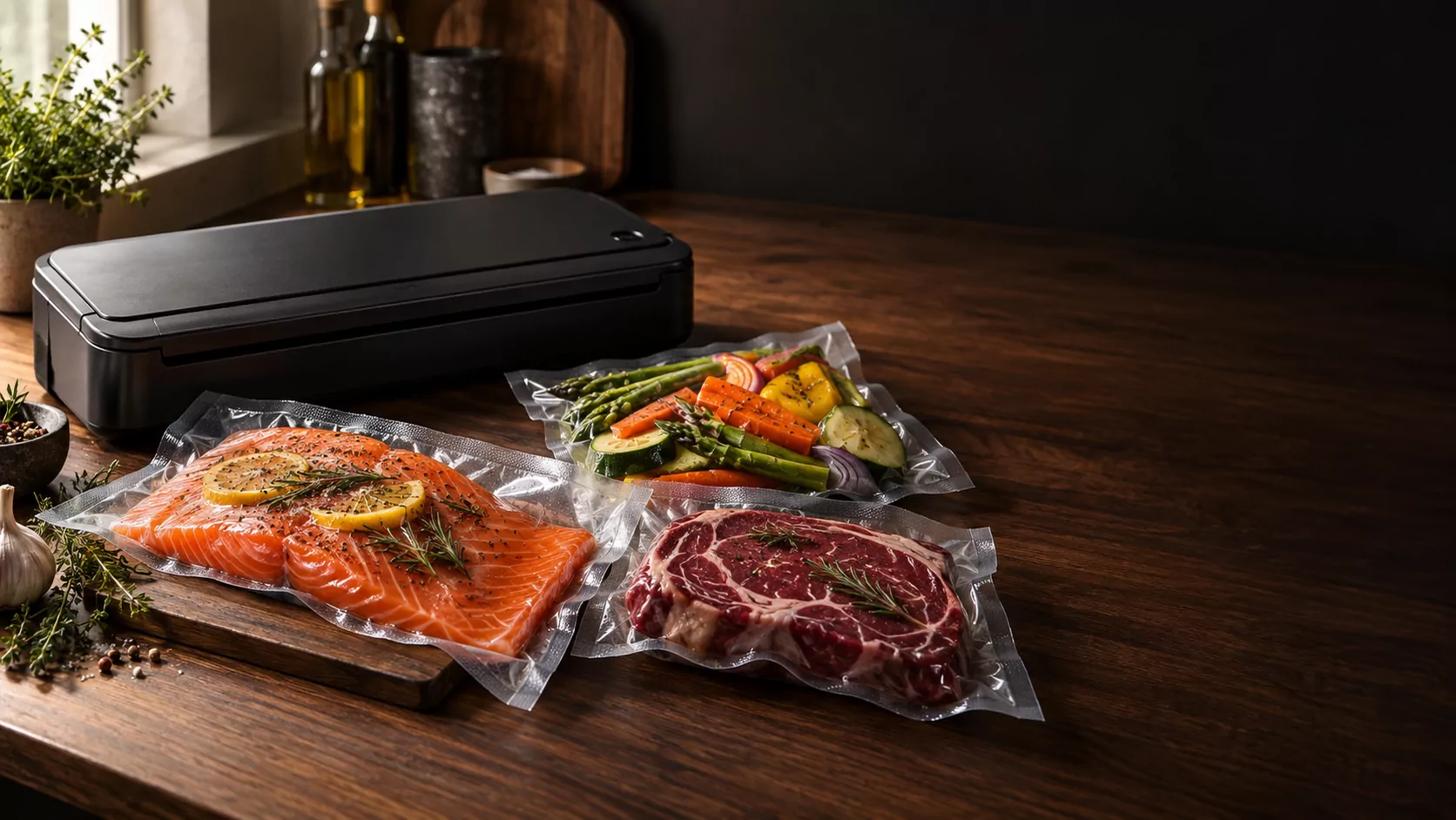
This guide is for anyone buying a first vacuum sealer, or replacing the one already on the counter, and trying to decide between an external (suction) sealer, a chamber sealer, and a handheld model. In a few minutes you will know which type fits your kitchen, which bags you need, and what to check before you pay.
As an Amazon Associate I earn from qualifying purchases. The price you pay does not change.
Decide in 30 seconds
Three profiles, three paths. If one of them sounds like you, start there and save the table for later. If two of them do, let weekday use break the tie: the machine you use most is the one that gets in the way least.
Como asociado de Amazon, gano por las compras que califiquen. Esto no cambia el precio que pagás. Más información
- You cook now and then and want to keep leftovers, freeze meat in portions, or make the most of a sale at the store. Start with the guide to home vacuum sealers; if you want a compact model to begin with, the FoodSaver Everyday is the one we review in detail.
- You cook almost every day, do meal prep or sous vide, and need to seal liquids without workarounds. A chamber sealer is the next step: the Avid Armor USV20 review shows one at work up close.
- You work at volume: restaurant, catering, deli, or a production kitchen. Different factors carry the weight here — cycle time, cleaning, and parts availability; start with commercial vacuum sealers.



The five types, in one table

The table compares categories, not brands. Use it to narrow down: once you know which row is yours, go to that category page and compare specific models.
| Type | Who it’s for | Level | Bags it uses | Liquids | Typical investment |
|---|---|---|---|---|---|
| Handheld | Travel, meal prep away from home, kitchens with no counter space | Beginner | Valve or zipper bags made for the unit | No: solids and dry goods only | Low |
| External (suction) sealer, entry level | Occasional home use | Beginner | Embossed bags or universal rolls | Limited: freeze first or use a moist mode | Low |
| External sealer with double seal and moist mode | Frequent home use, weekly portions | Intermediate | Embossed bags, rolls, and some containers with an accessory | Yes, with a drip tray or moist mode | Mid |
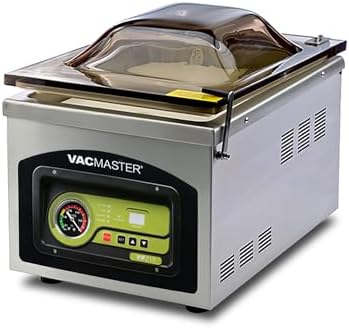
| Compact chamber sealer | Heavy home use, sous vide, liquids | Intermediate to advanced | Smooth bags, no air channel | Yes, with no workarounds | High |
| Countertop chamber sealer | Restaurant, catering, production | Professional | Smooth bags, in several gauges | Yes | High |
The Typical investment column is a relative tier within each category, not a price. Actual prices are set on each product listing and change over time.
The table also does not tell you how loud a machine is, or whether you will still find parts for it in two years. That gets checked on the product listing and in each category guide. And if two rows work for you, take the simpler one: a well-sealed external sealer covers more than a chamber machine you never clean.
How to choose: seven criteria that change the decision
If you already have two or three models on a short list, these are the points that separate a good purchase from a machine that ends up in a cabinet.
- Chamber or external. An external sealer seals from the outside: the bag stays open at one end until the machine pulls the air and closes it. A chamber sealer puts the whole bag inside a closed compartment, removes the air from the entire space, and then seals. That is why a chamber handles liquids and smooth bags, while an external sealer needs channeled bags and some care with moisture. For freezing solid portions, an external sealer is enough.
- Air removal and the kPa number. Pump speed is the air the pump moves per minute; kPa is the pressure difference it reaches. Few listings publish pump speed, so the comparison happens in kPa, and only between machines of the same type. A high number on a handheld does not equal the number on a chamber unit: the pump is different and so is the volume of air it has to move.
- Double seal. Two heat lines instead of one. If one fails or a fold gets in the way, the other holds. It matters if you freeze a lot, use large bags, or plan to reuse a bag.
- Proprietary or universal bags. Some brands require their own bags or containers; others take universal rolls. Before you pay for the machine, look at what a roll costs and how easy it is to find: that is the expense that comes back every month.
- Counter space. An external sealer needs clearance to open the lid and an edge to rest the bag on; a chamber unit weighs more and stays in one spot. Measure the counter and think about where the machine lives when you are not using it. In a small kitchen, a handheld that fits in a drawer can be more realistic than a chamber sealer with nowhere to sit.
- Noise. External and chamber sealers make pump noise; handheld units are quieter because they move less air. If your kitchen opens onto the rest of the house, watch a video of a full cycle before you decide.
- Parts and consumables. Replacement seal, drip tray, filters, and bags. A machine with no available parts becomes furniture the day the seal wears out — and that day arrives with use.
What you can vacuum seal

Almost anything that fits in a bag, with two exceptions: what gets crushed by suction, and what keeps ripening.
- Red meat and poultry, in portions, for freezing.
- Fish and shellfish, with no smell in the freezer.
- Blanched or already-cooked vegetables.
- Cheese and cured meats, so they do not dry out.
- Sauces, soups, and stocks: frozen in a mold and sealed afterward, or straight in if you have a chamber sealer.
- Prepared meals and portions for the week.
- Coffee beans and nuts, away from moisture.
- Bread: better frozen and sealed than sitting in an open bag.
- Herbs and spices, in small bags.
- Non-food items: documents, emergency clothing, a tool kit.
Two things do not improve under vacuum: raw vegetables, which keep respiring and ferment if sealed without blanching, and soft foods such as fresh bread or ripe strawberries, which get crushed. In those cases, freeze first and seal after.
How to use it, step by step
- Prep the food: cool anything cooked and dry the surface. Moisture at the edge prevents a clean seal.
- Choose the bag and leave a few inches free at the opening, plus room for the air to escape. If the bag comes on a roll, cut straight: a crooked edge seals badly.
- Put the open edge into the machine and lay the bag flat over the sealing bar, without wrinkles.
- Close it and start the cycle. If your machine has a moist or gentle mode, use it for juicy meat and sauces.
- Check the seal: it should be one continuous line, with no folds or bubbles. If air got in, cut and repeat.
- Label with date and contents, and store the bag flat to make the most of freezer space.
Five mistakes that ruin a seal
- Filling the bag to the edge. Food blocks the air channel, the vacuum never completes, and the seal comes out weak.
- Sealing hot food. Steam pushes against the heat line and bubbles appear; let it cool first.
- Using the wrong bag. A smooth bag does not work in an external sealer: with no channel, the pump cannot pull the air out.
- Sealing raw vegetables. They keep respiring and ferment inside the bag; blanch them before sealing.
- Putting the machine away without cleaning the drip tray. Dried residue clogs the channel and suction drops without you noticing.
Frequently asked questions
What is a vacuum sealer and what is it for?
It is a machine that removes the air from a bag and then seals it with heat. It keeps food longer, prevents freezer burn, and helps you organize portions.
How long does vacuum-sealed food last?
It depends on the food, the temperature, and how cleanly you handle it: refrigeration gains days and freezing gains months compared with the same food without vacuum, so the valid reference is the storage guidance for each food, not the box the machine came in. Seal in portions you will eat at once, because every opening exposes the food to air again.
Do I need special bags?
Yes. External sealers need embossed or channeled bags; chamber sealers use smooth bags. An ordinary kitchen bag will not seal and will ruin the cycle.
Can I seal liquids or soups?
In a chamber sealer, yes. In an external sealer, only with a moist mode or by freezing first; a handheld is not built for it.
Which vacuum sealer is the best value?
There is no single answer: for occasional use, an external sealer with a double seal covers the basics; for daily use with liquids, a chamber sealer removes the freeze-first step. The guide to home sealers lays out the criteria by budget.
What maintenance does it need?
Clean the sealing bar and the drip tray after each use, dry them well, and check the seal. When sealing starts to fail, it is almost always the seal or the gasket, not the machine.
Take the next step
If your use is at home, go to the guide to home vacuum sealers and compare by size, bags, and how often you cook. If you work at volume, the guide to commercial vacuum sealers covers cycles, cleaning, and parts.
And if you are already comparing specific models: the FoodSaver Everyday for a compact kitchen, or the Avid Armor USV20 if you want a chamber sealer.