The FoodSaver Everyday is a compact external vacuum sealer for household use. It draws air from an open-ended bag and heat-seals the mouth, one bag at a time. That one line explains both what this machine does well and where it stops.
The short verdict: as a first sealer for portioning meat, flattening leftovers, and keeping cheese, coffee, and dry goods out of the air, it is enough machine with a near-zero learning curve. If liquids or volume are central to how you cook, skip it and put the money toward a chamber sealer. The dividing line is not build quality. It is what goes inside the bag.
As an Amazon Associate I earn from qualifying purchases.
What it is
An external, or suction, sealer in the entry tier. You load a textured bag, lay the open mouth across a suction channel, and close the lid. A pump pulls air out through the channel while the bag collapses around the food, then a heated strip fuses the inner layers into a seam.
Because the bag seals against outside air rather than inside a vacuum chamber, usable vacuum is capped by atmospheric pressure and by how cleanly the bag mouth sits on the channel. That is a category property, not a defect. It is also why external sealers are light and cheap, and why chamber machines cost several times more.
The body fits a counter or a drawer, with cord storage in the base. Controls are a small labeled panel, and the cycle runs itself once a bag is detected.
Who it fits and who should skip it
It fits you if:
- You cook in batches and freeze in portions you want flat and stackable.
- You buy meat, cheese, or coffee in quantities larger than a week’s use.
- Space is tight, and a machine that stores away is the difference between using it and not.
- You will run it a few times a week, not all day.
- You pack solid or semi-solid food, and you will freeze wet dishes before sealing them.
Skip it if:
- You regularly seal liquids, stews, or marinades. A chamber sealer handles those without workarounds; this does not.
- You want to seal whole large cuts or anything near a commercial format.
- You will seal daily and the ongoing cost of bags is a real budget line.
- You want the widest seal and heaviest bag material for long freezer storage.
- You are unsure you will use one. A basic bar sealer will tell you the same about your habits for less.
What we could verify
These attributes are stated on the source page. Nothing here is inferred from a listing we have not checked.
- Bag format: takes the standard roll widths used by compact external sealers, and works with generic bags made for thermal vacuum sealing.
- Seal modes: separate settings for dry and moist food.
- Automatic cycle: a sensor detects the bag, starts the pump, and finishes with a heat seal without a separate manual step.
- Drip tray: removable and dishwasher-safe, which matters because it is the part that gets dirty.
- Accessory hose: included, for vacuum canisters and jars, including open wine bottles.
- In the box: rolls and bags in several sizes, the hose, and a manual in multiple languages.
- Size class: compact body with integrated cord storage.
- Intended use: household, not commercial.
We are not listing wattage, vacuum pressure in kPa, dimensions, weight, warranty length, or decibel figures. The source page does not state them, and copying numbers from an unverified listing is how wrong specs get published and then quoted.
How it works in practice
- Pick the bag size before the food. A wide roll for anything bulky, a narrow bag for single portions. Cutting too short is the most common first-timer mistake.
- Leave two to three inches of clean, dry bag above the food. Moisture or crumbs in the seam area stop the bag from fusing, and you find out in the freezer.
- Lay the mouth flat across the channel and close the lid. A wrinkled bag leaks air back in, and the machine keeps running without sealing.
- Select dry or moist and start the cycle. The machine detects the bag and runs the pump. Let it finish; lifting the lid early cancels the seal and wastes a bag.
- Check the seam before freezing. Run a thumb along it. A good seam is one clear band with no wrinkles, bubbles, or trapped food. If it looks wrong, cut below it and reseal.
- For jars and canisters, swap to the hose. Attach it to the accessory port and the jar lid valve. This is also the route for marinating, since there is no dedicated marinate button.
Pros and cons
| Pros | Cons |
|---|---|
| Small enough for a drawer, with cord storage, so it gets used instead of shelved. | Bags and rolls are a recurring cost forever. The machine is the cheap part of owning a sealer. |
| Dry and moist modes plus a removable drip tray make messy food survivable, which many entry sealers skip. | Free liquid still cannot be sealed. Moist mode handles damp food, not a cup of stock. |
| The accessory hose extends it to jars, canisters, and open wine bottles. | Entry-tier seal width and a single heating strip mean one seam at a time. Twenty portions is twenty cycles. |
| Controls are labeled and the cycle is automatic, so the first session is not a tutorial. | It is loud the way external sealers are: short, high, and repetitive during a night batch. |
| The compact footprint suits small kitchens and apartment counters. | Bag width is limited by the seal bar, so large cuts are out. Gaskets and the channel need wiping to keep seals reliable. |
The consumables point deserves emphasis. Every bag is money, and the habit that makes a sealer worth owning, packing everything, is the habit that burns through rolls. Seal two portions a week and bags never cost much. Seal twenty and they become a grocery line item.
The liquid limitation is the second. Moist mode is not a licence to seal soup. It changes how the pump behaves around damp food; it does not create room for free liquid, and no external sealer solves that, because suction passes through the bag mouth where the liquid is.
FoodSaver Everyday vs a chamber sealer
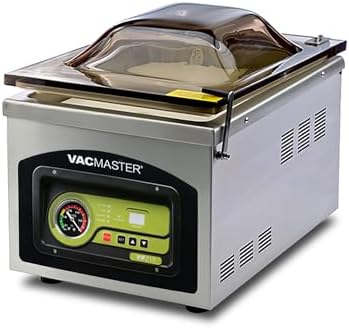
A chamber sealer puts the entire bag inside a vacuum chamber. Air leaves the chamber, the bag collapses, and the seam forms while pressure is still low. Because the bag never fights atmospheric pressure at its mouth, it can hold liquid, use smooth and cheaper bags, and take a wider seal.
That matters in three cases: you seal liquids or wet dishes regularly; you seal in volume, where bag cost and handling time compound; or you seal items that a narrow bag will not take.
It does not matter if you portion raw meat, freeze leftovers flat, and store dry goods. An external sealer does that completely. Paying several times more to seal chicken thighs buys a capability you will not use, in a machine that is heavy and hard to move.
There is a middle position. If your problem is liquids rather than volume, jars and the included hose cover much of it for far less. If your problem is volume, no accessory fixes it, and the chamber machine is the honest answer.
FAQ
Can I use third-party bags? Yes, if they are made for thermal vacuum sealers and have the textured channel that lets air escape. Smooth chamber-only bags will not draw air, and no amount of fiddling fixes that.
Can it seal liquids? Only indirectly. Moist mode and the drip tray handle damp food, but free liquid gets pulled into the channel before the seam closes. Freeze wet dishes first, or use a jar with the hose.
How much longer does food keep? The usual claim for this category is three to five times longer than ordinary storage, and it depends on the food, its starting temperature, and the seam. Treat it as a direction, not a guarantee, and date everything.
Is it loud? Yes, in the way all external sealers are: a short, high run of a few seconds per bag. Noticeable at night, not a reason to avoid the category.
Can I marinate with it? Yes, using vacuum containers or reusable bags with the hose rather than the bag channel. There is no dedicated marinate button, but the vacuum does pull marinade in faster than soaking alone.
Verdict
Buy the FoodSaver Everyday if this is your first sealer and your use case is solid food in portions: meat broken down for the freezer, leftovers flattened into packs, cheese, coffee, nuts, and dry goods kept away from air. In that role it is compact, simple, and complete. The condition is that you accept bags as a subscription and keep liquids out of the bag.
Do not buy it if liquids or volume are central to how you cook. That is not a knock on this machine. It is the boundary of the external-sealer category, and technique does not get you past it.
Como asociado de Amazon, gano por las compras que califiquen. Esto no cambia el precio que pagás. Más información
Still deciding between formats? Start with our guide to home vacuum sealers and match the machine to what you actually seal.



END OF ARTICLE COPY